Independent nature & risk advisory for European financial institutions
A nature risk picture your CRO can defend in a regulatory dialogue.
Fixed scope, six weeks, delivered by the senior practitioners who scope it. No junior staffing pyramid.
Co-architect of PBAF's biodiversity accounting standards, used by 70+ financial institutions.
Most financial institutions have made commitments on nature. Few have the internal capacity to deliver on them. Buy the capability, not the headcount: senior practitioner expertise on demand, no learning curve on the frameworks, and outputs that regulators, investors, and boards can act on.
What regulators say
Assessing nature-related risk is not some kind of tree-hugging exercise. We are talking about material financial risks, which — like any other type of risk — must be assessed, analysed and managed.
Climate and nature related risks affect both sides of insurers' balance sheets, making them critical for both financial supervision and corporate sustainability reporting.
The systemic risk hiding in plain sight
Nature loss is not a future risk.
It is a present one — systematically mispriced.
Institutional attention flows to what is measurable: geopolitical volatility, inflation, credit risk. Nature risk is different — slow-moving, systemic, cumulative. It accumulates in the background, unpriced in portfolios, until the exposure becomes impossible to ignore.
The sectors most affected are not peripheral. Agriculture, real estate, utilities, food processing — these sit at the core of European credit and insurance books. DNB found that 36% of Dutch financial institutions' portfolios — €510 billion — is exposed to companies highly dependent on ecosystem services. That exposure is largely unquantified at the institution level. What cannot be measured cannot be managed, priced, or disclosed.
A drought is simultaneously a credit event, an insurance loss, and a supply chain disruption. These interdependencies compound across portfolios in ways that standard risk models do not capture.
For individual institutions, the cost of inaction is now specific. DNB, ECB, and EIOPA expect nature risk integration in ORSA and ICAAP frameworks, governance structures, and disclosures. An institution that cannot demonstrate that integration faces supervisory findings and — as the ECB's updated guidance makes explicit — capital adequacy implications.
An ECB-supervised institution was fined in 2025 for failing to complete a climate and environmental risk materiality assessment. Nature risk is on the same supervisory trajectory.
Closing that gap — between regulatory expectation and institutional readiness — is what Invariant Earth does.
€510bn
Dutch financial institutions' exposure to nature-dependent companies
36%
of total portfolios assessed — largely unquantified at institution level
DNB, Indebted to Nature, 2020
What we do
Most clients come to us with one of three situations.
Each situation maps to a specific set of services. The engagement always starts with a direct conversation — not a proposal.
01
"I need a practical nature risk picture my CRO understands."
Most institutions have data. Few have turned it into a clear, plain-language picture their CRO can read, question, and act on.
Three progressive engagement levels, from first screening to financial quantification. Each level stands alone or builds on the previous one.
Entry — Portfolio hotspot analysis. We map an investment portfolio, loan book and/or underwriting portfolio using the updated ENCORE knowledge base and Invariant Intelligence's modelled six-tier supply-chain methodology. Outputs include dependency and potential environmental-pressure hotspots by sector, country of origin and supply-chain tier; the ten largest exposure concentrations and priority nature pathways; and a supervisory-alignment note mapped to ECB Good Practice 5.1.1 on identifying nature-related exposures.
This is a decision-useful exposure and sensitivity screen that identifies where deeper analysis is most warranted. It does not yet quantify financial risk: local ecosystem condition, asset and supplier vulnerability, transmission channels and financial consequences are added in subsequent tiers.
Delivery within six weeks of receiving complete, validated client data, with a management-ready decision memo and a transparent methodology and limitations annex.
Advanced — Risk-driver deep dives. Targeted analysis of the two or three drivers most material in the Entry tier using driver-specific datasets. Produces counterparty segmentation by risk tier and draft KRIs ready for insertion into your risk appetite framework.
Scenario — Financial quantification. Explore how biodiversity loss, ecosystem degradation, water stress and nature-related policy, market and liability shocks could affect portfolios, business models and financial performance. We combine client data with leading company, asset, location and environmental datasets to establish a defensible baseline, develop plausible physical and transition scenarios, identify financial transmission channels and assess portfolio resilience. Where data and suitable calibrations allow, we extend the analysis to quantitative stress testing of selected credit, investment or underwriting risks.
Grounded in ECB good practice 5.1.3 (Scenario analysis), May 2026, and the EBA Guidelines on environmental scenario analysis (EBA/GL/2025/04, effective 1 January 2027) — including biodiversity, water stress and ecosystem condition as scenario factors alongside climate. Covers exposure baseline, scenario design, financial stress quantification, and handoff to your credit risk team: stressed revenues, EBITDA compression, and debt serviceability indicators, formatted for your existing credit risk models. 1 January 2027 is the deadline for institutions without an existing framework to have one in place. Proportionality applies to how advanced that approach has to be, not to when you start: smaller institutions can rely on a predominantly qualitative approach or sensitivity analysis, while larger institutions are expected to progressively integrate more sophisticated quantitative approaches over time, not by a cutoff.
- Water curtailment → stressed RWA. A three-month water curtailment scenario simulates production stoppages for companies in sensitive areas; the resulting revenue and cost shock is translated into stressed internal ratings and stressed risk-weighted assets for the corporate loan book.
- Environmental permit revocation. One institution models the halt of client operations following loss of an environmental permit due to water pollution, nitrogen emissions or land use — with no government compensation. Exposures at default (EAD) are estimated per sector and risk driver.
- Water pollution tax. The same institution also runs a second scenario introducing a water pollution charge, calibrated to EU Directives, estimating EAD impact at sector level.
For 2026, Invariant Earth and GIST Impact are running a limited number of Entry-tier pilot scans on preferential terms — by selection.
Discuss this with Invariant Earth02
"I need to build internal capability — I don't have the knowledge."
Senior nature risk expertise is scarce and slow to hire. Two ways to bring practitioner capability into your organisation — from expert-on-call to a practitioner embedded in your team.
Two levels, depending on your internal capability and how embedded nature risk is in your regulatory agenda.
Retainer — Expert on call. Fixed monthly access to a senior Invariant Earth practitioner — sense-checking methodology, reviewing disclosures, interpreting new guidance (DNB, ECB, EIOPA, ESMA). Agreed turnaround, no project overhead.
Embedded — Practitioner in your organisation. A senior Invariant Earth practitioner working part-time inside your team, bridging sustainability and risk — CSRD/ESRS E4, TNFD, and nature risk integration into ORSA and ICAAP. The engagement flexes with the regulatory calendar. Knowledge transfer is built in: the aim is capability in your team, not dependency.
Discuss this with Invariant Earth03
"I want to build a defensible nature-positive strategy — and be recognised as a leader on it."
Commitments on nature are increasingly tested — by supervisors, investors, and NGOs. A defensible strategy links policy, targets, and capital allocation; a small number of institutions go further and want to be recognised as the ones who got there first.
Public-private nature investing — policy, strategy and implementation. We design impact investment strategies grounded in SBTN science-based targets and GBF alignment requirements, and translate those into portfolio-level investment criteria, screening frameworks and measurable milestones.
Discuss this with Invariant EarthFor institutions with a baseline risk picture already in place who want nature to define how they lead, not just how they stay compliant.
Discuss this with Invariant EarthWhat you actually receive
A redacted excerpt from an actual Nature Risk Scan memo.
The institution, portfolio figures and observations below are fictionalised for confidentiality. The structure, sections and heatmap format match what a board risk committee actually receives from an Entry-tier engagement.
1. Dependency screen — sector heatmap
Full loan book mapped by NACE sector against 25 ENCORE ecosystem-service dependencies. Highest-dependency concentrations sit in three services: water supply, pollination, and flood & storm protection.
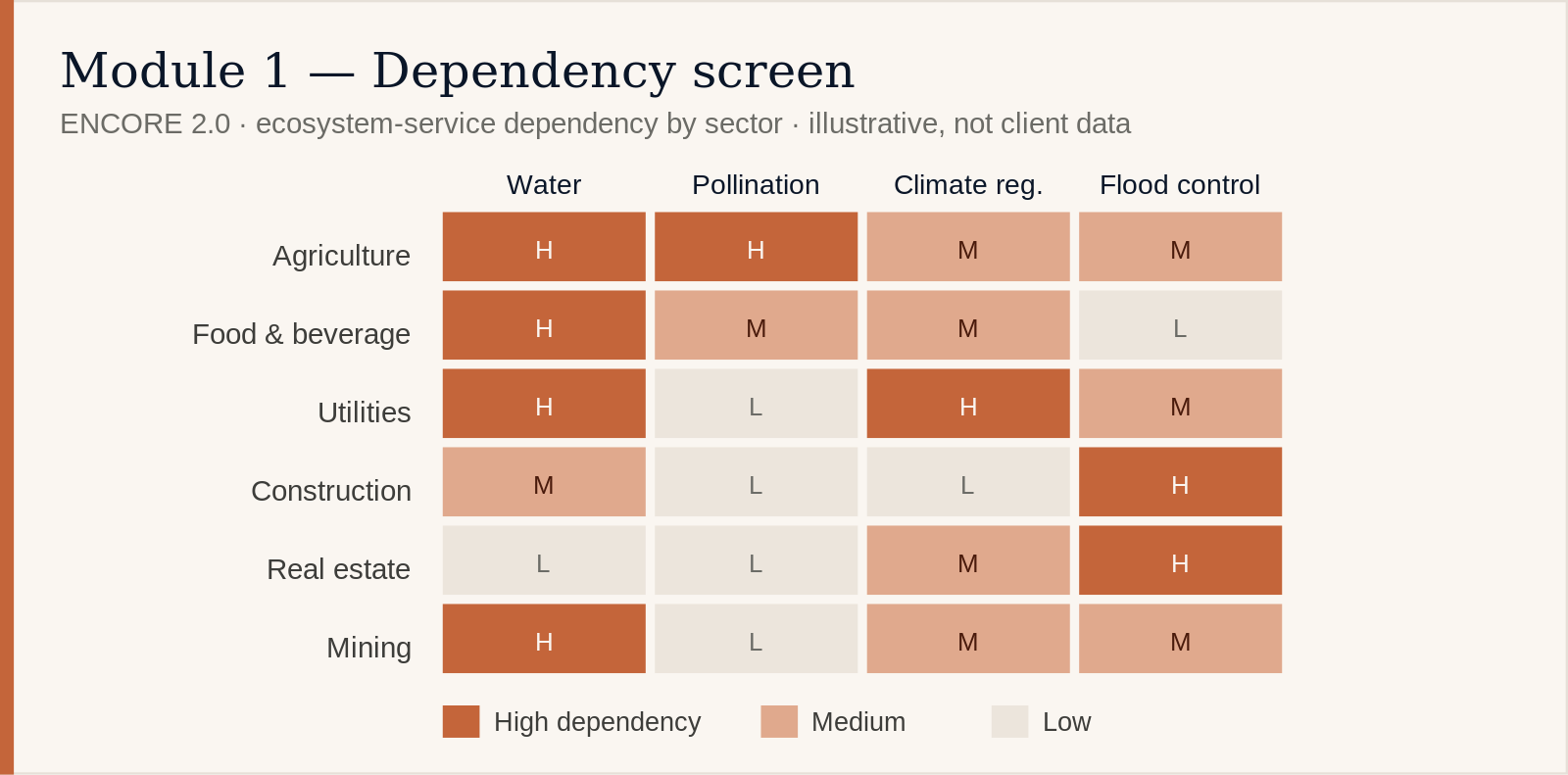
Figure 1. Illustrative dependency heatmap. Sectors, scores and figures shown are for illustration only — not client data.
2. Priority observations
- Agriculture and food & beverage exposures show high dependency on water supply and pollination — two services named in ECB supervisory commentary as priorities for 2026–2027.
- Utilities and mining concentrations warrant closer review under Module 2 (sensitive-location screening) ahead of the next reporting cycle.
- No immediate red flags at Entry-tier resolution — findings define where deeper analysis is warranted next, not a completed risk assessment.
This is an illustrative excerpt built to show format and structure only — the institution, figures and observations are fictionalised. The underlying data sources (GIST Impact · ENCORE) and the memo structure reflect an actual Invariant Earth deliverable.
Discuss what your scan would show
2026 pilot programme
Invariant Earth and GIST Impact are running a limited number of Entry-tier Nature Risk Scans on preferential terms — by selection.
Invariant Earth’s data layer combines GIST Impact’s science-based nature and biodiversity data with Invariant Intelligence, our own proprietary nature-risk data layer. The regulatory framing, interpretation, and advice are Invariant Earth’s.
Perspectives
Our view on nature risk, as it unfolds.
13 May 2026
1/3
of ECB's new good practices
dedicated specifically to nature
2027
EBA environmental scenario
analysis guidelines arrive
18 July 2026
18 April 2026
The world's largest sovereign wealth fund just told 7,200 companies to get serious about nature.
18 February 2026
€255 billion. That's what Europe needs to invest in water by 2030.
14 January 2026
About
Our purpose
Translating nature and climate data, tools, and science into intelligence that financial institutions can act on. By doing so, we contribute to the transition to a net zero and nature-positive economy.
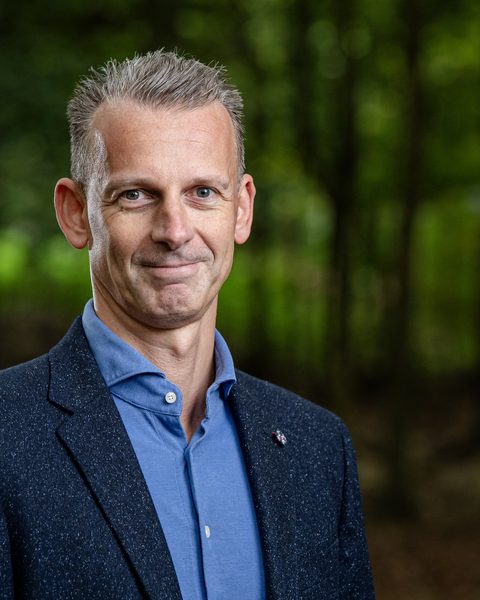
Founding Partner · Nature & Finance
Roel Nozeman
PBAF Programme Director. Former Nature Lead at NN Group. Former Head of Biodiversity at ASN Bank. Co-architect of PBAF's biodiversity accounting standards, used by 70+ financial institutions.

Founding Partner · Impact Investing
Esther Wolfs
Partner, Value of Nature. Impact Committee, SHIFT Invest. Former Founder, Wolfs Company. Former Partner, Grant Thornton.

Principal · Nature Risk Analytics
Thomas van Huyssteen
Postdoctoral Researcher, Institute for Environmental Studies, Vrije Universiteit Amsterdam. Research focus: natural capital, ecosystem-service dependencies, environmental pressures, and nature-related financial risk.

Associate Partner
Jurre Anema
Independent Advisor Impact & Sustainability. Former Grant Thornton. Advises investors on ESG and impact integration across strategy, due diligence and portfolio management. Helps translate complex sustainability topics, including nature-related risks and opportunities, into actionable insights for investment decision-making.
Invariant Earth is a nature-risk advisory practice for financial institutions. We help you to understand and quantify your nature-related dependencies, impacts, risks and opportunities — through focused advisory engagements such as nature risk scans, scenario analysis and board briefings. Every engagement is grounded in the frameworks regulators and boards actually use: TNFD, CSRD/ESRS E4, NGFS, and ECB and EIOPA supervisory guidance.
Invariant Earth was founded by Roel Nozeman and Esther Wolfs — senior practitioners with complementary expertise across nature, finance, and impact investing. Together they bring decades of hands-on experience building biodiversity strategies, co-architecting standards, and advising mid-tier and large financial institutions.
Each engagement is led directly by a partner. Beyond the partners profiled here, Invariant Earth draws on a wider network of senior associate partners and academic researchers, brought in selectively for the specific expertise each engagement requires.
Invariant Earth works with European banks, insurers, asset managers, impact investors and impact funds — from mid-tier institutions without a dedicated internal biodiversity function, to the largest institutions whose in-house teams still need the depth of specialist expertise a small, senior practice can bring. That is exactly the gap the practice was built to fill.
Board Briefing · 1–2 hours
A focused session for your management board, supervisory board, or senior leadership team — delivered directly by founders Roel Nozeman and Esther Wolfs.
Grounded in NGFS, ECB good practices and TNFD. No technical background required — your board leaves with a shared basis for informed oversight and future-proof decision-making.
Book a board briefingGet in touch
Book a 30-minute call
No pitch, no deck — just a direct conversation about whether Invariant Earth Partners can help.
Book a 30-minute callFollow us on LinkedIn