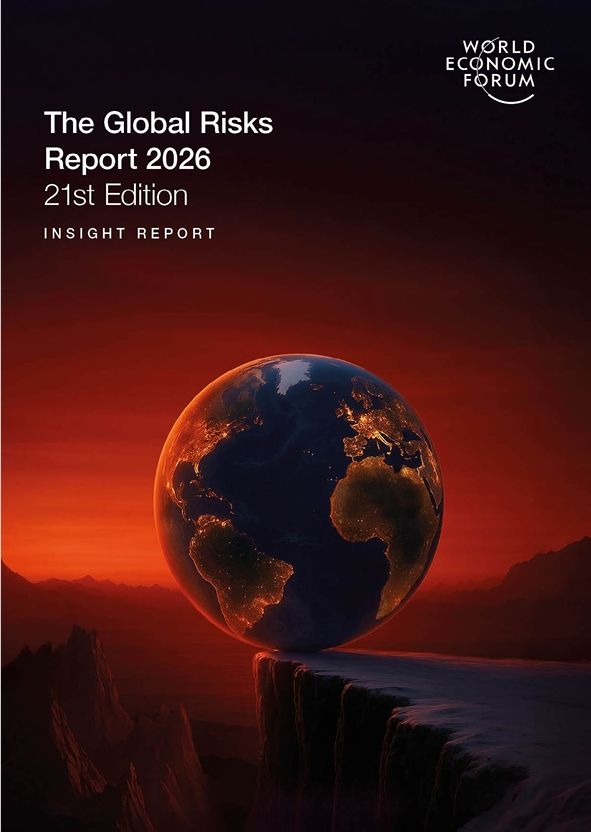
The Global Risks Report 2026, 21st edition — World Economic Forum.
The Global Risks Report 2026 reads like a mirror of how decision-making actually works under pressure.
When uncertainty rises, attention shifts to what is immediate, visible, and emotionally charged: geopolitics, conflict, inflation, misinformation. These risks feel urgent, concrete, and personal — so they dominate boardroom agendas and political debates.
At the same time, risks that are slow-moving, systemic, and cumulative — biodiversity loss, ecosystem collapse, critical Earth system change — quietly slip down the short-term rankings, despite remaining among the most severe over the next decade.
This isn't a contradiction in the data.
It's a reflection of how humans and institutions process risk.
Short-term shocks trigger rapid responses.
Long-term destabilisation requires sustained attention — and that's precisely what becomes scarce in an age of competition, fragmentation, and crisis-to-crisis management.
The danger?
By over-reacting to what is loud and under-reacting to what is structural, we increase future volatility. Environmental degradation, inequality and technological misuse don't disappear when ignored — they compound, interact, and eventually amplify the very geopolitical and economic risks leaders are trying to contain.
The real signal in this year's report is not which risks rank highest — but which ones systematically fail to trigger timely action.
And that gap between perception and reality may be the biggest risk of all.
Source: World Economic Forum, The Global Risks Report 2026, 21st edition, published 14 January 2026.